


Table of Contents
Have you ever wondered how a once-stable currency could collapse into hyperinflation, requiring multiple redenominations just to make the numbers manageable? The Venezuelan bolivar’s dramatic story provides a powerful lesson in economics. Understanding this currency’s journey helps explain how inflation can spiral out of control and what happens when governments lose control of their monetary policy.
The Early Bolívar: Gold Standard and Stability
The Bolívar was introduced in 1879, named after independence hero Simón Bolívar*. In the late 1800s and early 1900s it was tied to silver and then the gold standard, meaning each bolívar had a fixed value in precious metals*. This made the currency very stable. In fact, for decades the bolívar was one of Latin America’s most stable currencies*.
From 1930 until early 1980s, Venezuela often pegged the bolívar to the U.S. dollar (fixed exchange rates), keeping inflation low. But on February 18, 1983 – known as “Viernes Negro” or Black Friday – the government abandoned the peg and devalued the bolívar*. This marked the end of an era of stability. After 1983, inflation began to climb. In the 1980s and 1990s, each year saw rising prices and a weakening bolívar compared to the dollar. By 2007, decades of inflation had shrunk the bolívar’s value by roughly 500-fold*.
Stable vs. Unstable Currencies: Countries like Switzerland managed to avoid this fate. The Swiss franc, for example, has maintained low inflation by careful monetary policy. The Swiss National Bank targets inflation around 0–2%*, preventing runaway price rises. In contrast, Venezuela’s bolívar after 1983 would see soaring inflation and eventually hyperinflation. (For more on how the gold standard used to stabilize currencies, see The Gold Standard: Definition, History & Impact.)
The 1983 Turning Point
After the 1983 devaluation, inflation was always in double-digits. The bolívar lost value every year. By 2007 the government realized prices and salaries had so many zeros they were hard to use. So on January 1, 2008 Venezuela introduced the bolívar fuerte (“strong bolívar”). In this redenomination, 1 bolívar fuerte (Bs.F) replaced 1,000 old bolívares*. In other words, three zeros were chopped off. For example, a price of Bs 10,000 old bolívares became Bs.F 10. This made bookkeeping simpler but didn’t magically fix inflation*.
Bolívar Fuerte (2008–2018)
The bolívar fuerte (ISO code VEF, sign “Bs.F”) was meant to be a fresh start*. Initially it was pegged to the dollar, but Venezuela’s problems continued. Oil prices (the country’s main export) dropped sharply in the 2010s*, slashing government revenue. Hugo Chávez died in 2013 and Nicolás Maduro took over. The new government printed money to cover budget gaps*. Inflation exploded: by 2014 it was the highest in the world (around 69%), and then grew even faster.
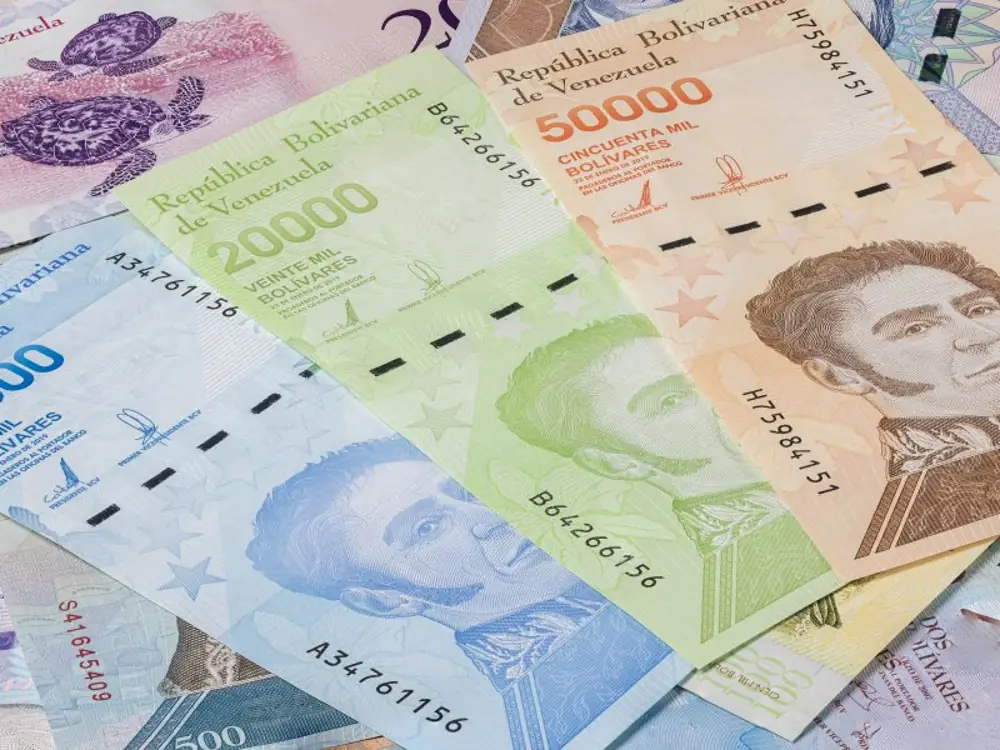
In late 2016 Venezuela officially entered hyperinflation*. Consumers saw prices doubling every few weeks. For example, by December 2016 prices were rising by over 50% per month, which meets the technical definition of hyperinflation*. By 2017 yearly inflation was estimated around 4,000%*. People needed wheelbarrows of cash to buy basic groceries. During this period, shops sometimes abandoned price tags because prices changed so fast. As one report noted, a clerk might tell you the price instead of it being printed*.
The social impact was severe. Venezuelans faced shortages of food, medicine and basics**. Long lines at stores became normal. Many protests and riots erupted over empty shelves and broken price controls**. Millions of people could no longer afford daily necessities; some could barely buy eggs or cheese with a month’s wage*. By late 2016 even the government stopped publishing official inflation stats because the numbers were uncontrollable*.
Why Hyperinflation Happened: Experts point to money-printing and fiscal deficits as the main causes. The central bank funded massive government spending by creating new bolívares*. With oil revenue plunging and little foreign investment, the supply of bolívares grew much faster than the economy’s goods. Basic economics says more money chasing fewer goods drives prices up. This unchecked printing led to hyperinflation and a collapse in confidence.
Bolívar Soberano (2018) and Bolívar Digital (2021)
As hyperinflation raged, Venezuela attempted more currency reforms. In August 2018 the government introduced the bolívar soberano (“sovereign bolívar,” code VES). This redenomination cut 5 zeros off the fuerte: 100,000 bolívares fuertes = 1 soberano*. In 2021, another reform replaced the soberano with the bolívar digital (code VED). The “digital” bolívar cut 6 more zeros: 1,000,000 soberanos = 1 digital*. In total, one digital bolívar now equals 10^14 of the original 1879 bolívars*.
These redenominations were largely symbolic. They did simplify accounting by shortening prices, but they did not restore value. In effect, each reform said “let’s rename the currency in smaller units,” but people’s real purchasing power stayed tied to global factors. Even after 2021, most Venezuelans used foreign currency in daily life – chiefly the US dollar (and in border areas, the Colombian peso)*. For many, paying in bolívares became more of a formality, with wages and prices often quoted in dollars.
Below is a quick comparison of the Bolívar’s stages:
- Original Bolívar (1879–2007): Introduced 1879. For many years it was on a gold standard** and remained fairly stable. By 2007 it had been inflated so much that 1,000 old bolívares became 1 in the next version*.
- Bolívar Fuerte (2008–2018): The “strong bolívar” (Bs.F) launched Jan 1, 2008. Redenomination: 1 Bs.F = 1,000 old bolívares* (3 zeros dropped). This was meant to simplify large numbers but inflation kept eroding value.
- Bolívar Soberano (2018–2021): The “sovereign bolívar” (Bs.S) launched Aug 20, 2018. Redenomination: 1 Bs.S = 100,000 Bs.F* (5 more zeros dropped). This was another attempt to cope with hyperinflation.
- Bolívar Digital (2021–present): Launched Oct 1, 2021. Redenomination: 1 Bs.D = 1,000,000 Bs.S* (6 more zeros dropped). The currency is now largely digital (electronic) but still subject to inflation.
Each stage simply scaled down the numbers by removing zeros. For example, a loaf of bread that cost Bs.F 10,000 (ten thousand fuertes) before 2018 would cost Bs.S 0.1 after August 2018 (because 10,000/100,000=0.1) – the real cost didn’t change*.
Causes and Impacts on Society
Causes: Venezuela’s economic collapse had multiple causes. As noted, falling oil prices in the 2010s robbed the government of revenue*. Venezuela depended on oil for about 95% of its export earnings by that time*. With low oil income, the government ran huge budget deficits. To cover the shortfall, it printed bolívar money*. The result was classic monetary overexpansion: too many bills chasing too few goods. Deficits and printing were compounded by price controls and expropriations that distorted markets.
Impact: The human toll was immense. With hyperinflation, savings and salaries became almost worthless. One report noted a public school teacher’s monthly pay could barely buy a dozen eggs*. Basic services broke down: hospitals lacked medicine, stores were empty, and power blackouts were common. People started using the bolívar in wheelbarrows or simply trading goods directly. Many Venezuelans coped by working multiple jobs (often abroad) or adopting US dollars for savings and transactions*.
Inflation also fed social unrest. In 2014–2017 there were large anti-government protests as people demanded solutions for shortages and corruption. By 2019 the crisis had driven millions of Venezuelans to emigrate to neighboring countries. It became a major refugee crisis in Latin America. In summary, the bolívar’s collapse mirrored Venezuela’s broader economic collapse – a combination of commodity dependency, poor policies, and loss of confidence.
Comparison: Stability vs. Hyperinflation
A useful comparison is with stable currencies. Take the Swiss franc. Switzerland’s economy is smaller, but the franc is a major global currency. The Swiss National Bank (SNB) aggressively maintains low inflation. It defines price stability as inflation between 0%–2%*. In practice, Swiss inflation often stays near 0–1%. No Swiss version of “Bolívar Fuerte” was needed because Swiss prices don’t explode.
Similarly, the US dollar and euro have faced some inflation over decades, but nowhere near hyperinflation. They were once linked to gold (the gold standard era) which anchored expectations. When the gold standard was abandoned in the 20th century, strong institutions (like independent central banks) managed inflation carefully. Venezuela, in contrast, left the gold standard early and did not maintain strict monetary discipline**. Its central bank often took orders from the government to fund spending.
In short, stable currency policies typically include limited money printing, diversified economies (not reliant on one export), and credible banks. Venezuela’s experience shows what can happen without those: even a currency with a proud history (like the bolívar on the gold standard) can collapse into hyperinflation and multiple redenominations**.
Conclusion
The story of the Venezuelan bolívar is a dramatic lesson in economics. The bolívar began as a stable, gold-backed currency in 1879*, but decades of inflation stripped its value. In 2008, 2018, and 2021 the government repeatedly cut zeros off the currency to cope with soaring prices**. Meanwhile, underlying causes – heavy money printing, budget deficits, and oil revenue crashes – drove inflation into the millions of percent**.
Key takeaways: Inflation erodes currency value over time (causing prices to rise)*. Hyperinflation occurs when inflation spirals out of control*, often due to excessive money printing*. Redenomination (dropping zeros) can reset the numbers but won’t fix the economy by itself**. Venezuela’s crisis shows the importance of sound monetary policy and economic diversity. Today’s bolívar (the digital bolívar) remains weak and largely sidelined – a symbol of a currency that once rose, then fell dramatically.
FAQ about Venezuelan Bolivar History and Hyperinflation
How bad was hyperinflation in Venezuela?
Extremely bad. By December 2016, prices were rising more than 50% per month. That qualifies as hyperinflation. Reports said inflation hit around 4,000% in 2017 and was projected to reach 10,000,000% by 2019. To understand, an item that cost 1 bolívar in 2017 would cost 100 bolívares a few months later. Wages, savings, and any fixed prices became nearly worthless. Hyperinflation outpaced people’s incomes, causing severe shortages and emigration*.
What’s the difference between devaluation and redenomination?
Devaluation is when a government lowers its currency’s value against foreign money. For example, if the bolívar was fixed at 5 per USD but is changed to 10 per USD, that’s a devaluation. It makes exports cheaper but imports costlier. In Venezuela, devaluation happened on Black Friday 1983 when the currency peg was dropped. Redenomination, by contrast, does not change value relative to other currencies; it just cuts zeros from the number. When Venezuela redenominated in 2008, 1 new bolívar fuerte = 1,000 old bolívares. That did not make the bolívar stronger – it merely simplified transactions.
Why didn’t the gold standard prevent the Bolívar’s collapse?
Venezuela left the gold standard long ago (in 1930*) to allow more flexibility. While the gold standard can prevent excessive money printing (since currency is tied to gold reserves), it also limits monetary policy. Venezuela chose inflationary policies instead. By the 1980s onward, the bolívar was floating and the central bank often financed deficits by printing money. The collapse happened decades later, well after gold backing ended, as inflation and economic problems grew. Many other countries have also abandoned gold and managed inflation successfully by other means (strong institutions, inflation targets, etc.), but Venezuela’s policies led to hyperinflation.
How do stable currencies like the Swiss franc avoid collapse?
Stable currencies share certain traits: disciplined central banks, low and steady inflation, and diversified economies. Switzerland, for instance, targets inflation of 0–2%. Its central bank intervenes when needed, but doesn’t print money out of control. Switzerland has a strong economy (finance, industry) not dependent on a single commodity. Venezuela’s economy, by contrast, was heavily oil-dependent. When oil revenues crashed and the government printed bolívares instead, inflation soared. Stable currencies typically maintain public confidence and modest inflation; Venezuela’s bolívar lost confidence under crisis conditions, leading people to use dollars or other assets instead.
